









How catechol bis(2-hydroxyethyl) ether (CAEE) improves toughness and processing over the HQEE benchmark in MDI-based polyurethane elastomers — with a high-purity, low-color grade.
Polyurethane elastomers are high-performance materials that bridge the gap between rubber and plastics, offering superior elasticity, wear resistance, and load-bearing capacity. They are synthesized by reacting three primary chemical components: diisocyanates, polyols, and chain extenders. The chain extenders are short-chain diols that react with diisocyanates to build polymer chains. Chain extenders dictate the elastomer’s performance by forming hard segments with the isocyanate that reinforce the soft polyol matrix, controlling the modulus (rigidity), tensile strength, mechanical properties, heat resistance, and abrasion resistance of the polyurethane. In Thermoplastic Polyurethanes (TPUs), diol extenders allow the hard segments to melt at high temperatures and reform when cooled, which makes the elastomer moldable and reprocessed.
Hydroquinone bis(2-hydroxyethyl) ether (HQEE) is the benchmark chain extender for high-performance polyurethane elastomers, but its high melting point and processing limitations present real challenges. Catechol bis(2-hydroxyethyl) ether (CAEE) is a new aromatic diol chain extender developed as a superior alternative for MDI-based elastomers. Across PTMEG/MDI systems (PTMEUs), CAEE delivers significantly higher tensile strength and toughness, very low tensile set, and easier one-pot processing.
Introduction
CAEE and HQEE are both aromatic diol chain extenders, but they differ in structure and behavior. CAEE has a lower melting point (84–85 °C) than HQEE (98–102 °C), which simplifies handling and processing, and it is miscible with many polyols. The structural difference — detailed below — is the basis for CAEE’s mechanical and physical performance.
The Kekulé structural formula for CAEE vs. that of HQEE is shown below.
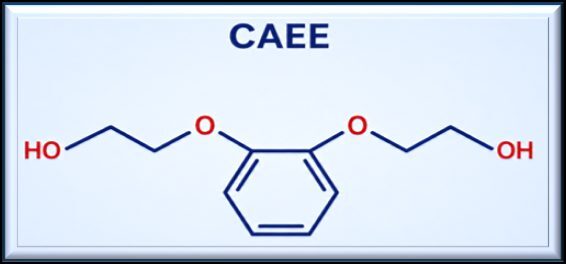
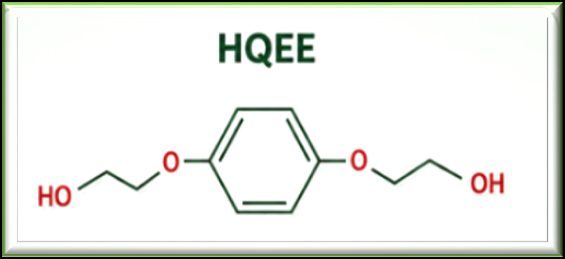
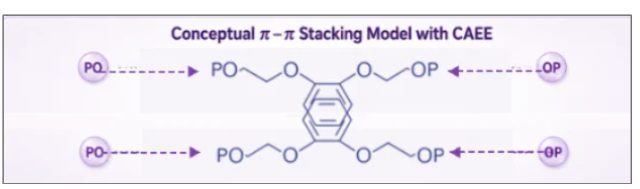
Models show that the CAEE structure when incorporated into polyurethanes exhibits a pendant aromatic group along the polyurethane elastomer backbone. This planar aromatic structure promotes π–π interactions, leading to the formation of stacked aromatic domains within the polyurethane hard segments.
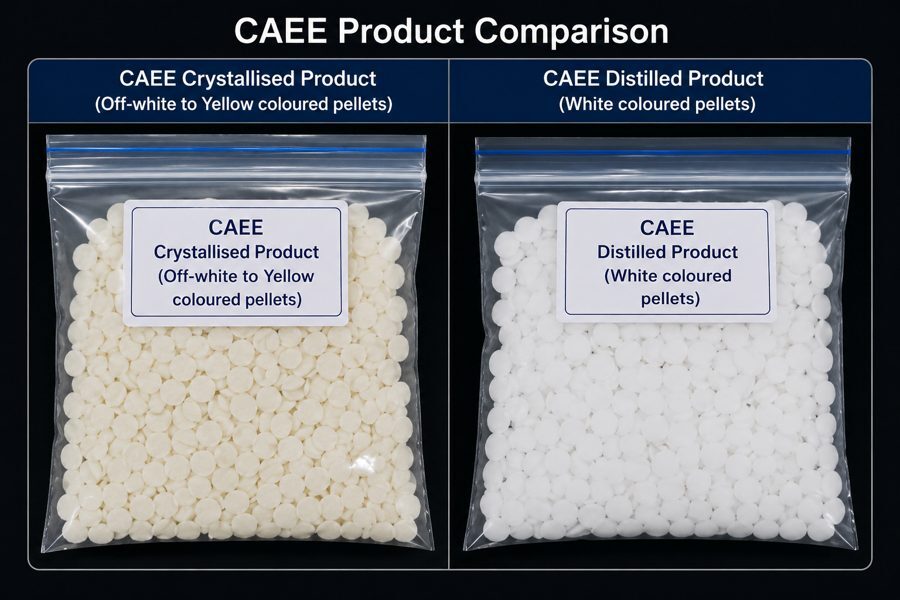
The distillation of aromatic diols such as HQEE is difficult and uncommon due to their high boiling and melting points, and the tendency to generate color and degradation products at distillation temperatures. However, CAEE can be vacuum distilled under controlled conditions to yield a chain extender with a distinctly white appearance relative to crystallized CAEE.
Performance Enhancements with CAEE
Use of distilled CAEE as a chain extender produces polyurethane elastomers that are visibly whiter than elastomers prepared with recrystallized CAEE. Cast, molded, or extruded articles prepared using distilled CAEE exhibit high initial whiteness and maintain color more consistently during storage and service. Polyurethanes manufactured with distilled CAEE also exhibit enhanced mechanical properties and greater consistency compared to polyurethanes produced using only recrystallized CAEE, as shown below.
| Property (PTMEG 2000 / MDI) | Crystallized CAEE | Distilled CAEE |
|---|---|---|
| Hardness, Durometer A | 87 / 86 | 88 / 86 |
| Rebound Elasticity | 52% | 56% |
| Ultimate Tensile Strength | 7,169 psi | 7,368 psi |
| Ultimate Elongation | 540% | 530% |
| Strength (work energy to break) | 855 in-lbs | 866 in-lbs |
| Tensile Modulus (500%) | 5,100 psi | 5,250 psi |
| Tensile Set – 30 min | 6% | 6% |
| Die C Tear (D624) | 504 pli | 582 pli |
| Clarity | Clear | Opaque |
| Gel Time (min) | 7 | 7 |
The practical payoff of the CAEE hard-segment structure is a step-change in mechanical performance: across PTMEG/MDI systems CAEE outperforms the HQEE benchmark on tensile strength, toughness, and tensile set — while processing more simply.
CAEE vs. HQEE in PTMEG/MDI (PTMEU)
In processing, CAEE is compatible with a simplified one-pot process, whereas HQEE requires pre-blending with PTMEG to suppress freezing. To keep reaction conditions consistent across both systems, both CAEE and HQEE were run as blends in the PTMEG polyols, allowing a representative comparison. MDI was introduced at 20 °C and the mix held at 85 °C (FlackTek™, 1200 rpm, 1.5 min, vacuum degassing), then cast and post-cured (gel times >4 min; cure 100 °C for 10 hours).
| Formulation | Durometer A/D | Tensile (psi) | Tensile Set % | Elong. % | Die C Tear (pli) | 1938 Tear (pli) | Ball Rebound RT % |
|---|---|---|---|---|---|---|---|
| MDI / PTMEG 1000 / HQEE | 60D | 4,790 | 14 | 180 | 628 | 107 | — |
| MDI / PTMEG 1000 / HQEE | 93A | 5,013 | 8 | 280 | 644 | 106 | 30 |
| MDI / PTMEG 1000 / HQEE | 85A | 5,268 | 7 | 350 | 462 | 80 | 19 |
| MDI / PTMEG 2000 / CAEE | 56D | 8,078 | 21 | 500 | 967 | 382 | 53 |
| MDI / PTMEG 1000 / CAEE | 93A | 8,117 | 3 | 480 | 559 | 183 | 26 |
| MDI / PTMEG 1000 / CAEE | 82A | 5,832 | −2 | 450 | 420 | 84 | 20 |
The combination of high tensile strength, high elongation, and very low tensile set indicates minimal phase mixing in the CAEE–MDI hard block. CAEE PTMEU systems show tensile set of −2% and +3%, versus 7–8% for the corresponding HQEE systems — evidence of an effective hard-block structure with minimal molecular slippage.
Results: Strength and Toughness
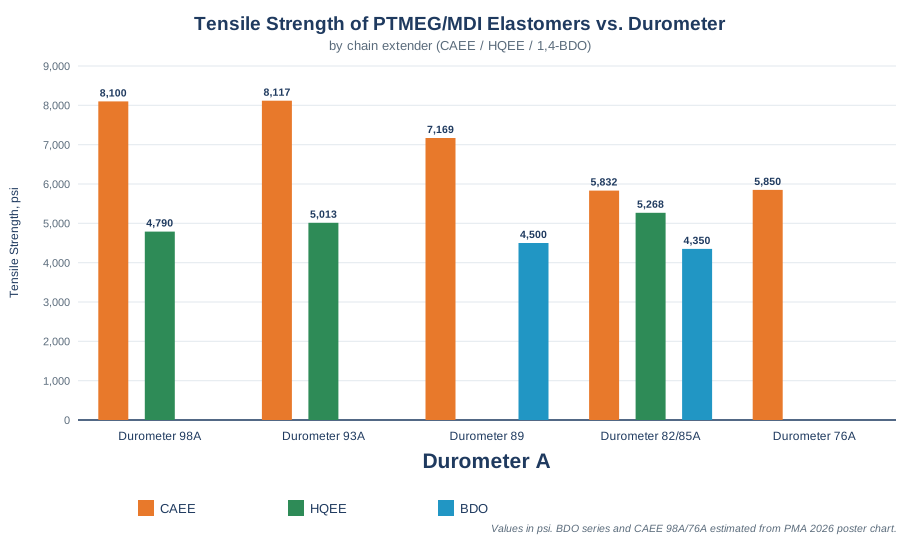
Across PTMEG/MDI systems, CAEE tensile strengths are significantly higher than comparable HQEE and 1,4-BDO systems at every Durometer hardness, and elongation is higher as well — so CAEE-based polyurethanes are consistently tougher.
The tensile strength of PTMEG/MDI systems chain extended with CAEE, HQEE or 1,4-BDO are compared in the chart below. CAEE tensile strengths and elongation values are significantly higher than the comparable HQEE and BDO systems, at all Durometer values. The result is that the PTMEG/MDI/CAEE based polyurethanes are consistently much tougher.
CAEE with various polyols
CAEE also performs across polyol families — PTMEG, polycaprolactone (PCL), PO3G (poly(trimethylene ether) glycol), adipate polyester polyols, and a HDO-based polycarbonate polyols. The results with PCL are particularly striking: CAEE and PCL 2000 polyols are miscible at 60 °C, and at 94A Durometer the elastomer reached a tensile stress above 8,000 psi without deformation or break, with a notable 826 in-lbs. of energy absorption. The 94A elastomer also held a stable Durometer value over time, showing no cold hardening affects.
| Formulation | Durometer A/D | Tensile (psi) | Tensile Set % | Elong. % | Die C Tear (pli) | 1938 Tear (pli) | Ball Rebound RT % |
|---|---|---|---|---|---|---|---|
| MDI / PTMEG 2000, CAEE, Dabco/T-12 | 89 | 7,169 | 6 | 540 | 504 | 194 | 52 |
| MDI / PCL 2000, CAEE, Dabco/T-12 | 94 | >8,000 | 8 | 550 | 813 | 420 | 34 |
| MDI / PO3G, CAEE, T-12 | 93 | 5,268 | 8 | 545 | 620 | 225 | 27 |
| MDI / Polyester 2000 / CAEE | 92 | 6,051 | 6 | 600 | 656 | 416 | 29 |
| MDI / PCD 2000 / CAEE | 88 | 6,350 | 2 | 565 | 446 | 226 | 25 |
Processing Example: MDI / PTMEG / CAEE
CAEE is an excellent, compatible chain extender for MDI/PTMEG systems. The following examples show the high physical properties achievable with the PTMEG/MDI/CAEE system.
Two formulations are shown below in the 90–95A Durometer hardness range — Formulation 1 with PTMEG 1000 and Formulation 2 with PTMEG 2000. The MDI is a carbodiimide-modified MDI (Cosmonate LL, 29.4% NCO). The catalyst in Formulation 2 was a blend of 1 drop of DABCO 33LV and 1 drop of a 20:1 blend of a 3000 MW PPG diol and T-12.
| Component (grams) | Formulation 1 (PTMEG 1000) | Formulation 2 (PTMEG 2000) |
|---|---|---|
| CM-MDI (Cosmonate LL) | 90.16 | 67.79 |
| PTMEG | 121.83 (OH 113.4) | 149.6 (OH 56.7) |
| CAEE (OH 545.20) | 38.01 | — |
| CAEE (OH 543.03) | — | 32.37 |
| Catalyst | None | 1 drop each |
| Mix temperature | CAEE/PTMEG at 90 °C, CLL at 20 °C | All at 70 °C |
PTMEG, CAEE, and catalyst (where used) were mixed, thoroughly degassed, and conditioned to the temperatures shown to form a homogeneous solution. The MDI, at room temperature, was then added and final mixing done in a FlackTek machine under vacuum at 1000 rpm — 1.5 min for Formulation 1 and 2 min for Formulation 2. Molds were preheated to 110 °C, and the mixtures poured easily into the aluminum molds. Gel times were approximately 10 minutes for Formulation 1 and 7 minutes for the catalyzed Formulation 2. Total cure time was 10 hours at 110 °C, with demolding after about 1 hour.
| Property | Formulation 1 | Formulation 2 |
|---|---|---|
| Durometer A | 94 | 91 |
| Tensile (psi) | 8,117 | 7,368 |
| Elongation (%) | 480 | 530 |
| Tensile Set (%) | 3 | 6 |
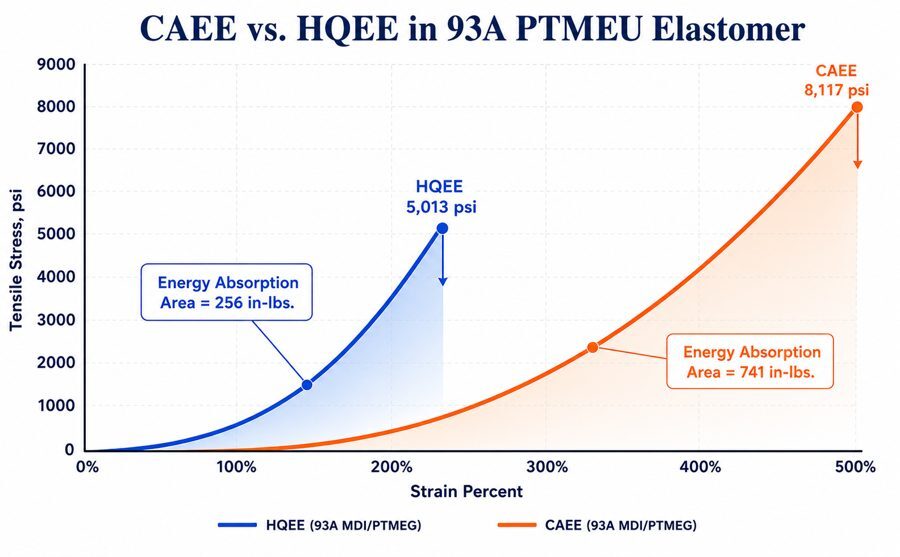
| Energy Absorption (in-lb) | 741 | 866 |
| Die C Tear (pli) | 559 | 582 |
| 1938 Tear (pli) | 183 | 180 |
| Rebound (%) | 26 | 56 |
At equal hardness, the CAEE elastomers show up to approximately three times the toughness — energy absorption before rupture — of the corresponding HQEE elastomers.
Performance–Temperature Profiles
Dynamic mechanical analysis (ASTM D4065) on laboratory plaques shows very good phase separation for CAEE, reflected in its low glass-transition temperature. The lower tan δ for CAEE indicates lower rolling resistance and energy absorption.
| DMA — MDI-PTMEG 2000; 85 Shore A | CAEE-(PTMEU) | HQEE-(PTMEU) |
|---|---|---|
| Tg | −55 °C | −34 °C |
| Tm | 142 °C | 157 °C |
| Tan δ (Delta) @ 20 °C | 0.094 | 0.12 |
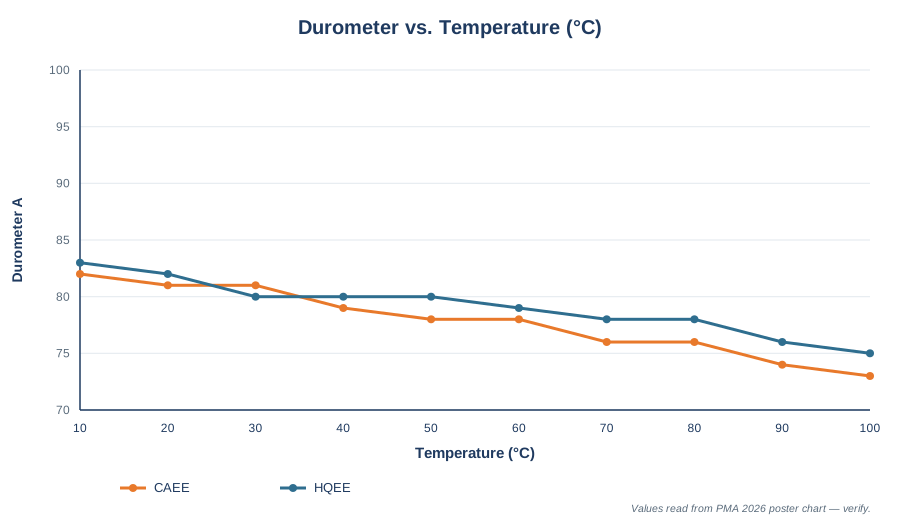
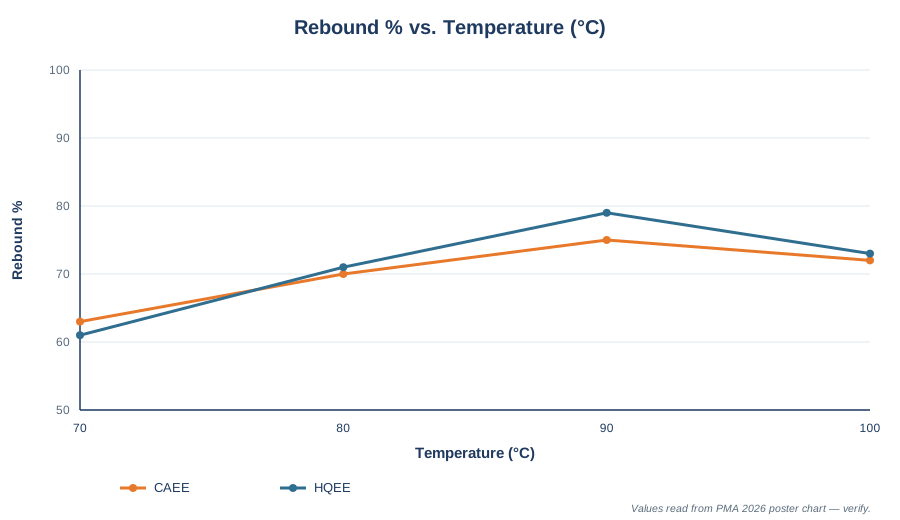
At 82–83A Durometer (PTMEG 1000/MDI), the temperature profiles of CAEE and HQEE elastomers are quite similar, and both show excellent resiliency and rebound.
A MOCA-Free Aromatic Chain Extender
CAEE offers a MOCA-free route to high-performance polyurethanes. For formulators facing tightening restrictions and customer pressure to replace MOCA, CAEE/MDI systems offer the mechanical properties, toughness, and processing advantages described above.
Applications
CAEE’s combination of toughness, processing ease, and color stability suits demanding, high-performance polyurethane applications, including:
- High-load industrial wheels & tires, forklift tires
- Recreational wheels
- Pipe linings & protective coatings
- Paper machine filtration fabrics, shoe press sleeves
- Seals, gaskets & sprockets
- Belting & conveyor systems
- Oil field & mining components
- Other high-performance polyurethane applications
Conclusion
CAEE represents a next-generation aromatic diol chain extender:
- Very high tensile, elongation, energy absorption, and toughness
- Low tensile set values — efficient hard-segment formation
- Excellent low-temperature flexibility and high-temperature properties
- Suitable for one-pot, pre-polymer, and quasi-systems
- Excellent flow in a TPU with no loss of physicals when processed at 400 °F
- Distilled CAEE is white with a low discoloration tendency
CAEE outperforms the HQEE benchmark across every polyol system tested — higher tensile strength, greater toughness, lower tensile set — while processing more simply. Distilled CAEE is a whiter, more consistent product.