









100Polyurethanes based on polyester polyols, in general, exhibit higher tensile and tear properties, abrasion resistance, thermal stability, chemical resistance and weathering performance compared to polyether-based polyurethanes. They are preferred in the most demanding environments and applications. However, there is one weak point of polyester based polyurethanes. They are much more susceptible to hydrolysis compare with polyethers in polyurethanes. A part made of polyester based polyurethanes can gradually lose properties in a humid environment or water emersion.
2-Methyl-1,3-propanediol (MPO) based polyester polyols largely overcomes this deficiency due to the steric shielding of the ester linkage by the pendant methyl group on MPO, and greater hydrophobicity. MPO is an ideal diol intermediate for polyester polyols used in polyurethane elastomers (PURs). This is because MPOs unique structure enhances hydrolytic stability, affords liquid polyester polyols that are easier to handle, and demonstrates excellent compatibility in formulations.
Attributes of MPO based Polyester in Polyurethanes
MPO is a unique diol used in high performance urethane elastomers. MPO based polyester polyurethanes exhibit:
- Very good hydrolysis resistance while maintaining the overall favorable performance of polyesters in PURs.
- Exterior durability, gloss retention and optical clarity.
- The primary hydroxyl functionality in the polyol enhances urethane reactivity and consistency.
- The MPO polyester polyols are liquids which facilitates handling characteristics.
- A low tendency to crystallize in a PUR and “cold-harden”.
- MPO polyester based PURs exhibit excellent compatibility with other formulating ingredients.
- Increased flexibility, toughness, and abrasion resistance.
-
Polyurethanes with low durometer values

Polyurethanes based on MPO polyester polyols are utilized in a diverse range of applications, including coatings, adhesives, sealants, inks, aqueous polyurethane dispersions (PURs), water blown foams, laminating films, cast elastomers and thermoplastic polyurethanes (PURs).
Hydrolytic Stability of MPO based Polyester Polyols
Polyester polyols based on MPO demonstrate very good hydrolysis resistance while maintaining the overall good performance properties expected of polyester polyol PURs. Generally, the Durometer values of MPO adipate PURs are lower than those obtained with standard polyester polyols.
The figures below compare the hydrolytic stability of adipate based polyester polyols containing MPO to other commonly available polyester polyols. Hydrolytic stability was measured by mixing the subject polyol with 10 weight percent water and heating the mixture at 90 °C for up to 12 hours. The generation of acid through hydrolysis of the ester moiety is used as an indication of hydrolytic stability.
The data below shows the hydrolysis rates for a 1,4-BDO adipate polyol and a 50:50 BDO:EG co-polyester composition. Incorporating MPO in a 50:50 MPO:BDO diol or a 50:50 MPO:1,6-HDO adipate improved the hydrolytic stability. The homo-polyester based on MPO adipate polyol exhibited the highest resistance to hydrolysis in the simulated test method. Although this chart demonstration the hydrolysis rates for 2000 MW polyester polyols vs. the polyurethane elastomers, the graph exemplifies the same tendency of PURs containing these polyols.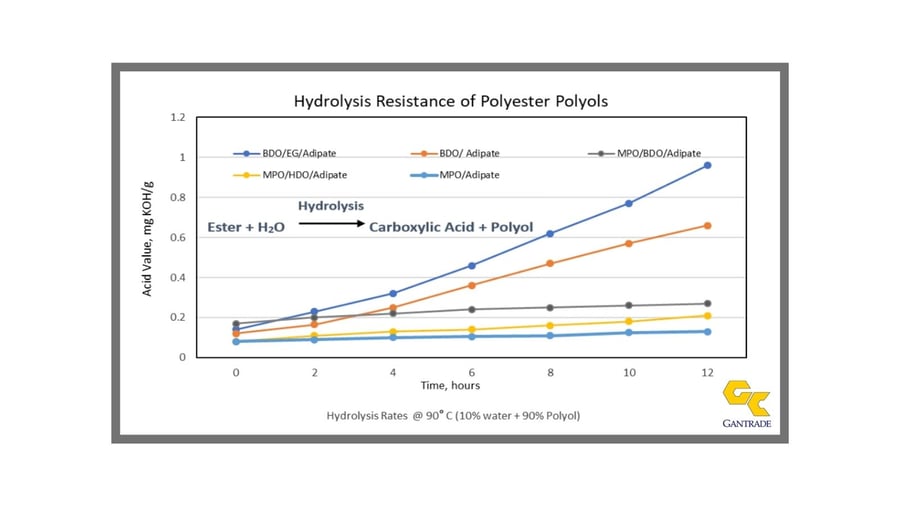
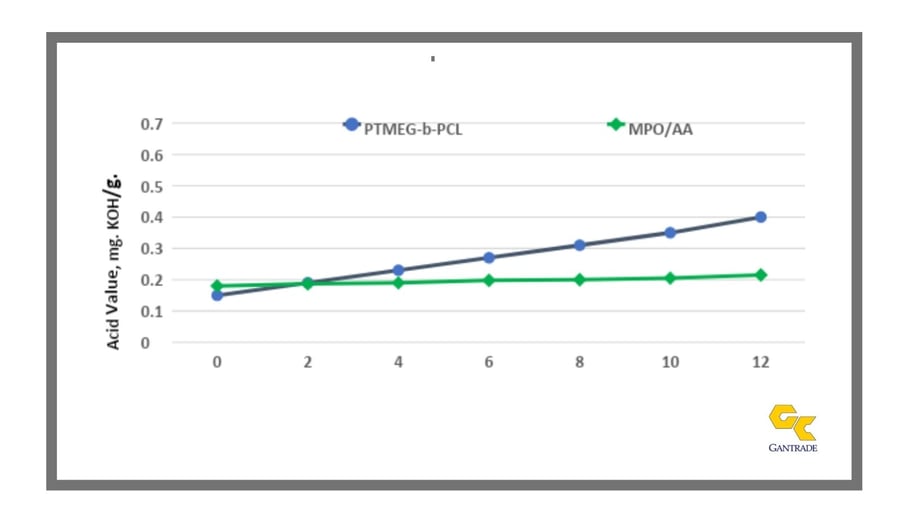
Beyond the above adipate polyester polyols, we compared a polycaprolactone-b-PTMEG co-polyol vs MPO adipate polyester polyol, at a MW of 1000. The caprolactone-b-PTMEG co-polymer, is regarded as the good combination of a polyether and hydrolytically stable caprolactone polyester. PTMEG-b-PCL represents the benefits of both ether and ester polyol properties in one polyol. On an expanded scale, the MPO adipate polyol exhibited greater hydrolysis resistance than the PCL-b-PTMEG co-polyether ester, albeit both exhibited relatively good hydrolytic stability.
Hydrolysis Resistance of MPO Adipate Polyol
vs PTMEG-b-PCL Polyol
Neopentyl glycol is considered the foremost base diol for a high-performance polyester in the coating industry. NPG offers excellent non-yellowing and gloss retention in outdoor applications, water resistance in boat or watercraft coatings, and serves as the performance standard in can/coil coatings and powder coatings. The figure below shows that an MPO adipate exhibits the same degree of hydrolysis resistance as the NPG adipate polyol. An ethylene glycol:diethylene glycol adipate polyol and a dipropylene glycol adipate polyol are included for reference.
Hydrolysis Resistance of MPO vs. NPG Adipates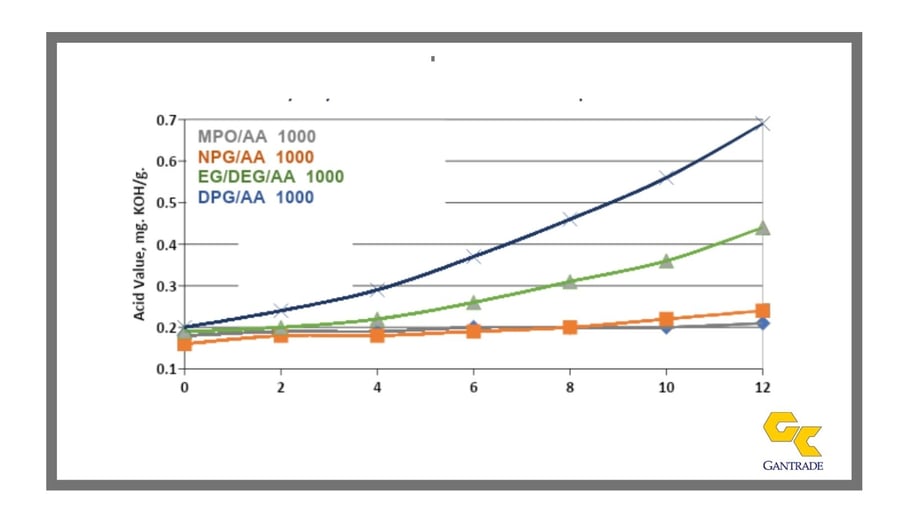
Viscosity Characteristics of MPO Adipates
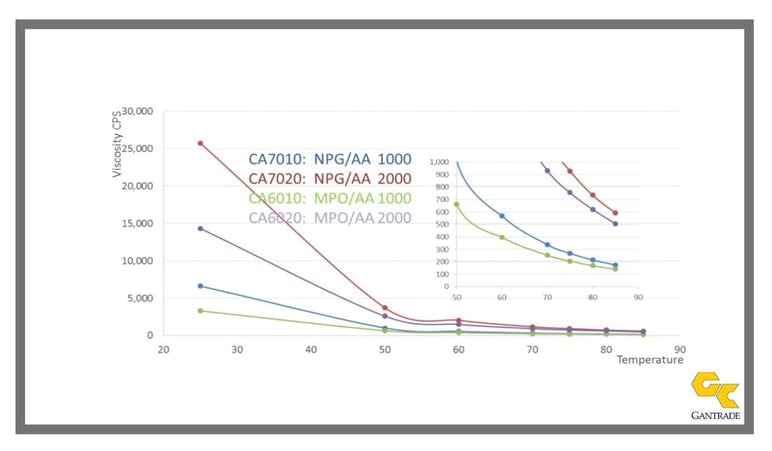
In the MPO adipate polyester polyol series, the viscosity increases with MW. The MW 1000 and 2000 MW grades are clear liquids at room temperature with a viscosity of 3000 and 7000 cps, respectively. The NPG based adipate polyols exhibit a higher viscosity at comparable temperatures. The viscosities comparisons at various temperatures are shown in the figure below.
MPO vs. NPG Adipate Polyester Polyols Viscosity
MPO Polyester Polyol Grades
The table below lists the commercial grades and sales specification for MPO based polyester polyols available from Gantrade Corporation. Note these polyols range from clear liquids to waxy liquids for the MPO:1,6-HDO adipates.
Enhanced Hydrolysis Resistance MPO Based Polyester Polyols
| Series | Dibasic Acids | Diols | Product Name | Acid Value | Avg. MW | OH Value | APHA | Moisture (%) | Appearance @ 25°C |
| CA16XX | AA | HDO, MPO | CA1610 | 0.5 max | 1000 | 106.0-118.0 | 50 max | 0.05 max | Liquid-Waxy |
| AA | HDO, MPO | CA1620 | 0.5 max | 2000 | 53.0-59.0 | 50 max | 0.05 max | Liquid-Waxy | |
| AA | HDO, MPO | CA1630 | 0.5 max | 3000 | 36.0-40.0 | 50 max | 0.05 max | Liquid-Waxy | |
| AA | HDO, MPO | CA1640 | 0.5 max | 4000 | 26.0-30.0 | 50 max | 0.05 max | Liquid-Waxy | |
| AA | HDO, MPO | CA1650 | 0.5 max | 5000 | 21.0-24.0 | 100 max | 0.05 max | Liquid-Waxy | |
| AA, IPA | HDO, MPO | CA1610i | 0.5 max | 1000 | 106.0-118.0 | 100 max | 0.05 max | Liquid | |
| AA, IPA | HDO, MPO | CA1620i | 1 max | 2000 | 53.0-59.0 | 100 max | 0.05 max | Liquid | |
| AA, IPA | HDO, MPO | CA1630i | 1 max | 3000 | 63.0-40.0 | 100 max | 0.05 max | Liquid-Waxy | |
| AA, IPA | HDO, MPO | CA1640i | 1 max | 4000 | 26.0-30.0 | 100 max | 0.05 max | Liquid-Waxy | |
| AA, IPA | HDO, MPO | CA1650i | 1 max | 5000 | 21.0-24.0 | 100 max | 0.05 max | Liquid-Waxy | |
| CA167XX | AA | HDO, NPG, MPO | CA16710 | 0.5 max | 1000 | 106.0-118.0 | 50 max | 0.05 max | Clear Liquid |
| AA | HDO, NPG, MPO | CA16720 | 0.5 max | 2000 | 53.0-59.0 | 50 max | 0.05 max | Clear Liquid | |
| AA | HDO, NPG, MPO | CA16730 | 0.5 max | 3000 | 36.0-40.0 | 50 max | 0.05 max | Clear Liquid | |
| AA | HDO, NPG, MPO | CA16740 | 0.5 max | 4000 | 26.0-30.0 | 50 max | 0.05 max | Clear Liquid | |
| AA | HDO, NPG, MPO | CA16750 | 0.5 max | 5000 | 21.0-24.0 | 100 max | 0.05 max | Clear Liquid | |
| CA26XX | AA | EG, MPO | CA2620 | 0.5 max | 2000 | 53.0-59.0 | 50 max | 0.05 max | Clear Liquid |
| AA | EG, MPO | CA2640 | 0.5 max | 4000 | 26.0-30.0 | 50 max | 0.05 max | Clear Liquid | |
| CA60XX | AA | MPO | CA6005 | 0.5 max | 500 | 212.0-236.0 | 50 max | 0.05 max | Clear Liquid |
| AA | MPO | CA6010 | 0.5 max | 1000 | 106.0-118.0 | 50 max | 0.05 max | Clear Liquid | |
| AA | MPO | CA6020 | 0.5 max | 2000 | 53.0-59.0 | 50 max | 0.05 max | Clear Liquid | |
| AA | MPO | CA6030 | 0.5 max | 3000 | 36.0-40.0 | 50 max | 0.05 max | Clear Liquid | |
| AA | MPO | CA6040 | 0.5 max | 4000 | 26.0-30.0 | 50 max | 0.05 max | Clear Liquid | |
| AA | MPO | CA6050 | 0.5 max | 5000 | 21.0-24.0 | 100 max | 0.05 max | Clear Liquid | |
| CA64XX | AA | BDO, MPO | CA6410 | 0.5 max | 1000 | 106.0-118.0 | 50 max | 0.05 max | Clear Liquid |
| AA | BDO, MPO | CA6420 | 0.5 max | 2000 | 53.0-59.0 | 50 max | 0.05 max | Clear Liquid | |
| AA | BDO, MPO | CA6430 | 0.5 max | 3000 | 36.0-40.0 | 50 max | 0.05 max | Clear Liquid | |
| AA | BDO, MPO | CA6440 | 0.5 max | 4000 | 26.0-30.0 | 50 max | 0.05 max | Clear Liquid | |
| AA | BDO, MPO | CA6450 | 0.5 max | 5000 | 21.0-24.0 | 100 max | 0.05 max | Clear Liquid | |
| AA, IPA | BDO, MPO | CA6410i-M1 | 1 max | 1000 | 106.118.0 | 100 max | 0.05 max | Clear Liquid | |
| CA68XX | AA, PA | MPO, TMP | CA6816P-M1 | 1 max | - | 100.0-110.0 | 100 max | 0.05 max | Clear Liquid |
| AA, pA | MPO, TMP | CA6820P-M1 | 1 max | - | 80.0-88.0 | 100 max | 0.05 max | Clear Liquid | |
| CA6920-N19 | AA | MPD, MPO | CA9020C | 0.5 max | 2000 | 53.0-59.0 | 50 max | 0.05 max | Clear Liquid |
| CA-A620 | AA | DPG, MPO | CA-A620 | 0.5 max | 2000 | 35.0-59.0 | 50 max | 0.05 max | Clear Liquid |
In the chart above, AA = adipic acid, PA = phthalic acid and IPA = isophthalic acid. The diols are as defined in the text.
Summary
MPO based homo- and co-polyester polyols afford enhanced hydrolytic stability and clarity in polyurethanes, while preserving the overall excellent mechanical properties associated with polyester based polyurethanes. They are liquids at room temperature which facilitate handling. MPO based polyesters are attractive candidates for PUR applications involving humid environments, water immersion and outdoor weathering. PURs formulated with MPO based polyester polyols show reduced Durometer values.
Applications include adhesives, laminating films, aqueous polyurethane dispersions (PURs), cast PURs, coatings experiencing environmental exposure, fabric coatings, inks, and sealants.
For more information on MPO polyester polyols and our entire lineup of diols and polyols, contact Gantrade today.